

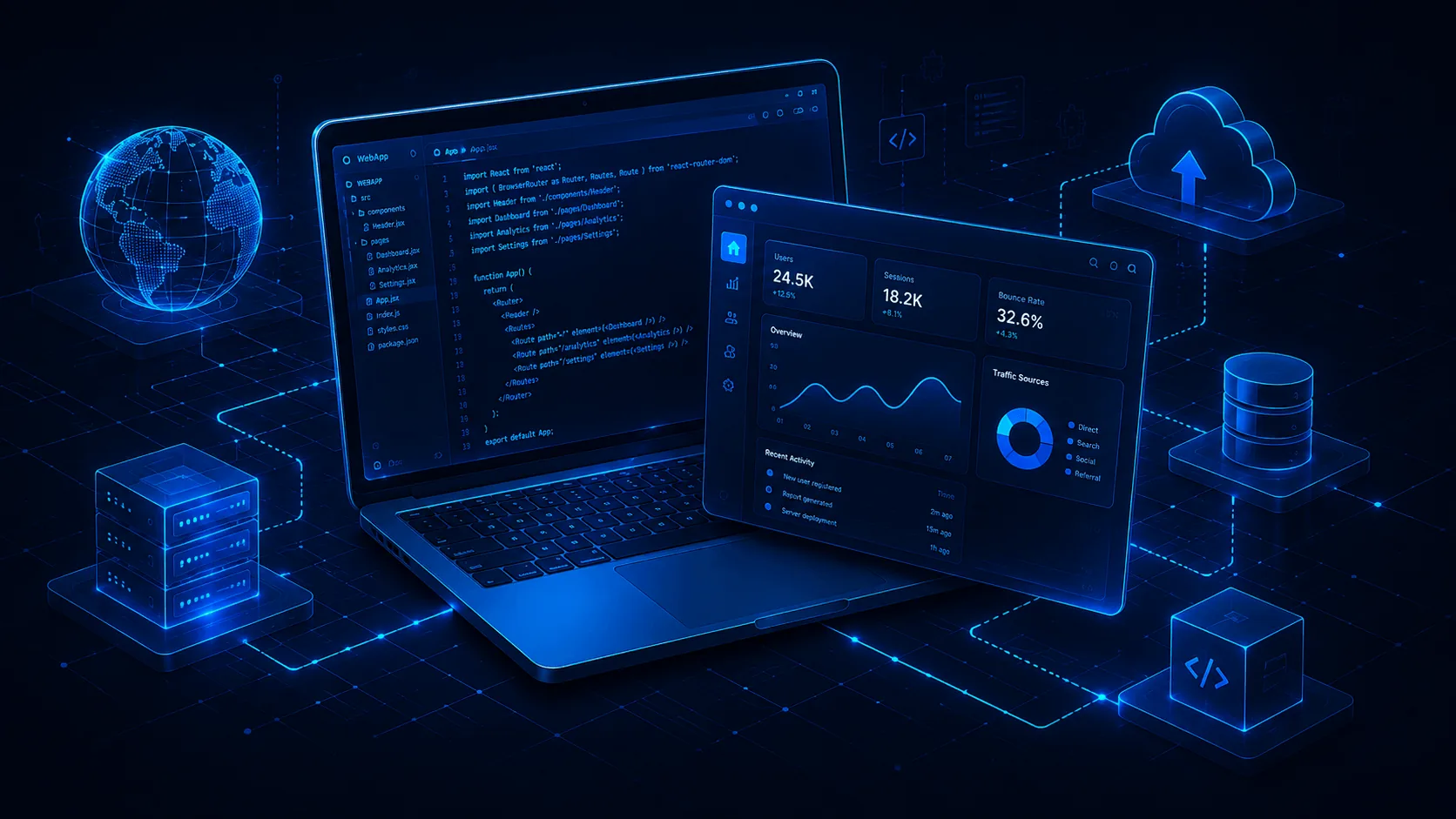
Web Application Development
The web application is where most of our clients' users actually meet the product. It carries the whole relationship — sign-up, daily use, support, renewal — which is why it has to stay fast and reliable long after launch day.
- Reply within one business day
- NDA on request
- No obligation
What this covers
Application front ends
React, Next.js, Angular and Vue interfaces — component systems built to be extended by your team, not just delivered once.
APIs and services
Node.js, Python, Go, Java and .NET back ends, exposed through versioned REST or GraphQL interfaces that other systems can rely on.
Performance engineering
Server rendering, code splitting, caching strategy and query optimisation, targeting first-load time and interaction latency rather than synthetic scores.
Real-time and streaming interfaces
WebSocket and event-driven surfaces for data that changes while the user is looking at it, with reconnection and backfill handled properly.
Progressive web apps
Installable, offline-tolerant web applications where a native build isn't warranted but a browser tab isn't enough.
Accessibility and browser support
Keyboard operability, semantic markup and screen-reader behaviour treated as build requirements rather than a pre-launch audit.
From first conversation to running software
- 01
Define the surface
Which screens exist, what data each needs, and which of them carry the load that will determine the architecture.
- 02
Architect data flow
API contracts and state boundaries agreed before UI work, so the interface isn't shaped by an accidental data model.
- 03
Build and instrument
Iterative delivery with performance budgets and error tracking wired in from the first deployed build, not retrofitted.
- 04
Harden and release
Load behaviour, failure modes, caching and rollback path checked before launch, with a deployment your team can run themselves.
Bring us the web application you need to scale
Discuss a web buildPlatforms we've built
Projects from our portfolio. Each has its own write-up.
Financial Media and Investment Education
RealVision

A cross-platform financial streaming service delivering expert analysis across web, mobile, iPad and TV.
- 40%
- Increase in user engagement through dynamic tools and content
- 200,000+
- Engaged members globally
- 4.5
- Average user satisfaction rating
Travel & Experiences Marketplace
PlacePass

A travel experiences marketplace spanning 300,000 activities in 800+ destinations, later acquired by Hopper.
- 300,000
- Experiences available across the marketplace
- 800+
- Destinations covered
- Acquired
- By Hopper in October 2021, forming its travel experiences division
EdTech — 3D & VR Simulations
Impactall

The backend, admin dashboard and initial web and mobile app behind Impactall's Be Curious learning platform.
What we build it with
Selected for what this kind of system needs, not a default toolkit.
Frontend

React
Next.js

Angular
Vue
TailwindCSS
Backend
Node.js

Python

Go

Java
.NET
Data

PostgreSQL
MySQL

MongoDB

Kafka
Where this work tends to land
Each of these sectors shapes the work differently — the industry page covers the specifics.
Web Application Development: common questions
01
Which framework will you use for our project?
It depends on what the application has to do. Server-rendered React through Next.js suits content-heavy products where first-load performance and search visibility matter; Angular suits large applications with many teams and a preference for strong conventions; Vue sits between them. If your team already works in one of these, that is usually the deciding factor — inheriting a stack nobody in-house can maintain is a bad trade.
02
Can you improve an existing application rather than rebuild it?
Often yes, and it is usually the better option. Performance problems, in particular, tend to concentrate in a small number of queries, bundle decisions and rendering paths. Measuring before rebuilding frequently shows the application is sound and a handful of specific things are not.
03
How do you approach performance?
By measuring the things users experience — how long until the page is useful, how long an interaction takes to respond — rather than optimising a score. That usually means server rendering where it helps, splitting code so the first load carries only what it needs, caching deliberately at each layer, and fixing the database queries behind the slowest screens.
04
Do you build the back end as well as the front end?
Yes, and we prefer to. When the same team owns the API contract and the interface consuming it, the mismatches that cause most integration delay simply do not arise. We can also work front-end only against an API your team owns.
05
Will our team be able to maintain what you build?
That is an explicit goal. We work in mainstream frameworks rather than proprietary abstractions, document architecture decisions as we go, and can run a transition period where your engineers work alongside ours before taking over.
Related services
Engage or staff this
Bring us the web application you need to scale
Whether it's a new build or an existing product under strain, tell us what it has to handle and we'll come back with a concrete assessment.
- Reply within one business day
- NDA on request