Energy Software Development
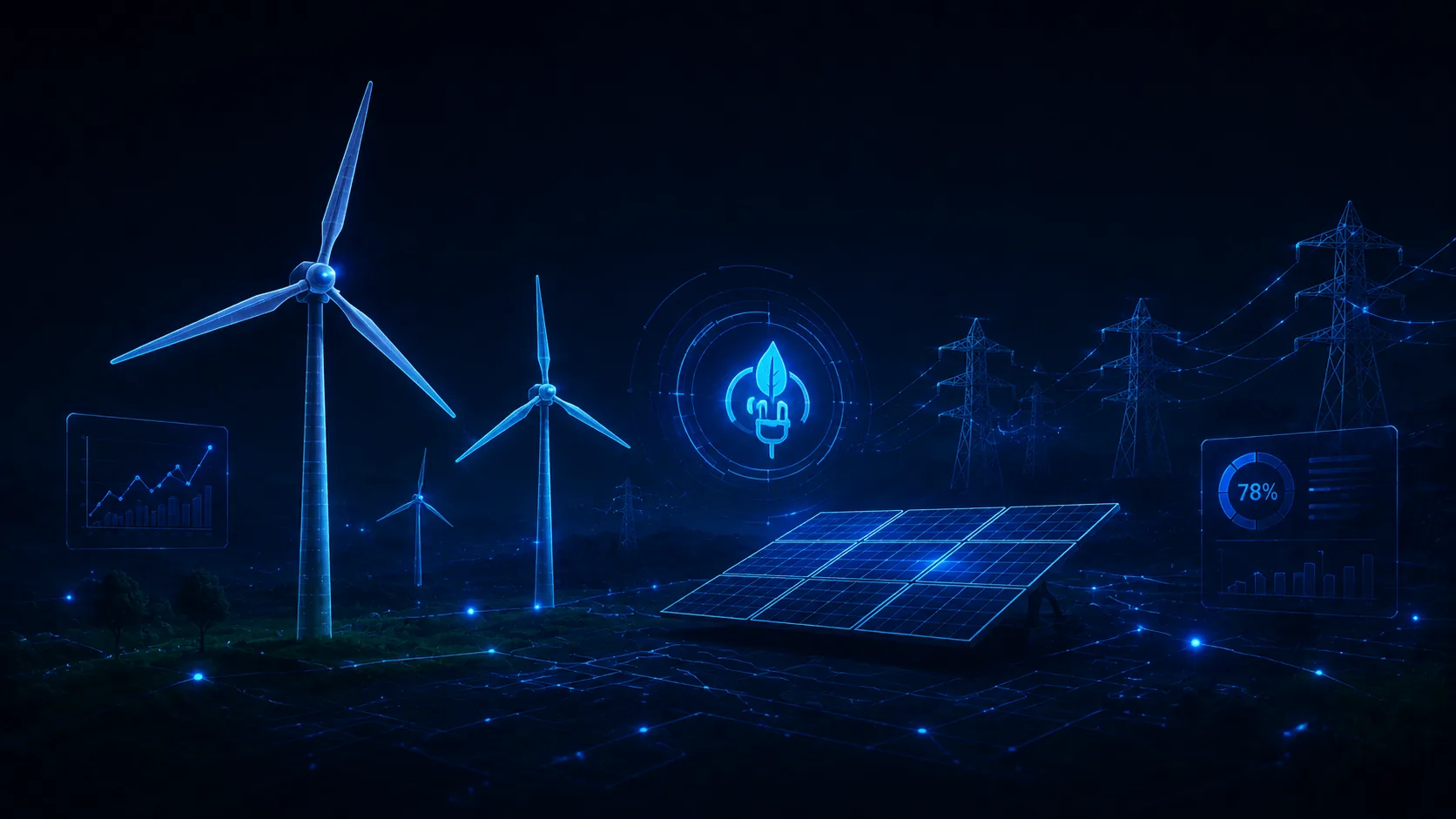
Energy assets are remote, long-lived and heavily reported on. Whether the asset is a rooftop solar array or an offshore platform, the software problem is the same shape: get reliable data off equipment you cannot easily reach, and turn it into something operations and regulators can both act on.
- Reply within one business day
- NDA on request
- No obligation
Constraints specific to energy
The problems that shape software here, and that generic engineering tends to discover late.
Assets are distributed and hard to reach
A portfolio may span hundreds of rooftops across a country, or a handful of platforms offshore. Either way the connectivity is thin, intermittent and often expensive, so what gets transmitted has to be chosen rather than assumed.
Generation data only matters against expectation
A raw output figure says little on its own. Performance is a comparison — against irradiance, against the model, against the same asset last month — which means the analytics layer, not the meter, is where the value sits.
Control systems are a hard boundary
Inverters, SCADA and process control carry safety and availability consequences. Monitoring software reads across a strictly governed boundary; it does not reach through it casually.
Reporting obligations are extensive and audited
Generation, emissions, incidents and inspections all carry regulatory or contractual reporting, which makes data lineage a compliance concern rather than an engineering nicety.
Assets outlive the software that monitors them
Equipment commissioned decades ago is still in service, and equipment commissioned today will outlast several software generations. Integration frequently means working with protocols that predate modern practice.
Software we build for energy
Generation and asset monitoring
Portfolio-wide visibility of output, availability and equipment state, with bandwidth-aware synchronisation for remote sites.
Performance analytics
Actual output measured against expected, with underperformance attributed to a cause — soiling, shading, inverter fault, curtailment — rather than reported as a number to interpret.
Customer and stakeholder portals
Interfaces giving offtakers, site hosts and internal teams the view each actually needs, from live generation to settlement-grade reporting.
Regulatory and contractual reporting
Generation, emissions and incident reporting where every submitted figure traces back to its source measurement.
OT-boundary data integration
Reading historian, SCADA and inverter data into analytics and business systems through an architecture that preserves control-system isolation.
Standards that apply to software in this sector
What the software has to be built to satisfy. Which of these apply to you depends on your jurisdiction, your data and your customers.
[ 01 ]
Industrial cybersecurity
- IEC 62443
- NIST CSF
[ 02 ]
Functional safety
- IEC 61508
- IEC 61511
[ 03 ]
Solar & storage
- IEC 61724 (PV performance)
- Grid codes
[ 04 ]
Environmental reporting
- Emissions reporting regimes
- I-REC / carbon credit records
- ISO 14001
[ 05 ]
Information security
- ISO/IEC 27001
These are the standards we design and build to meet. Certification or attestation of your organisation is a separate exercise, carried out by a qualified assessor — we can support that process with documentation and evidence, but we do not certify it.
Tell us what your assets can't report
Discuss an energy projectHow we'd approach it
The service lines this sector most often needs.
Data Analytics & Engineering
Pipelines, warehousing and reporting built so the numbers reconcile and people act on them.
IoT & Connected Devices
Connectivity, telemetry pipelines and fleet management for physical estates in the field.
Web Application Development
Scalable web applications on modern frameworks, engineered for first-load performance and sustained load.
Mobile App Development
Native and cross-platform iOS and Android apps, built for real network conditions rather than office Wi-Fi.
Custom Software Development
Bespoke systems shaped around your operations, integrated with the tools and data you already run on.
Projects in this space
Renewable Energy
Fourth Partner Energy
Web, Android and the data-crunching backend behind a distributed solar portfolio spanning 3,000+ projects.
Energy: common questions
Something specific to your operation?
Send it over — sector questions are the ones we most like getting.
Ask us01
Do you work on renewables, conventional energy, or both?
Both. The asset differs enormously but the software problem rarely does: distributed equipment in places people are not, producing data that has to travel over a constrained link and become a decision at the other end. Solar and storage portfolios and conventional operations end up needing much the same architecture.
02
Do you build software that controls generation equipment?
No, and the distinction matters. We build monitoring, analytics, reporting and customer-facing software that reads from operational systems. Safety instrumented systems and process control are a separate discipline governed by IEC 61508 and IEC 61511, with certification requirements and specialist vendors.
03
How do you handle constrained or expensive connectivity?
By deciding deliberately what crosses the link. Aggregation happens at the site, transmission is scheduled and prioritised, and full-resolution data stays local until it is actually requested — which turns bandwidth from something that breaks the system into a parameter it is designed around.
04
Can you integrate with our existing SCADA or monitoring platform?
Usually, through OPC UA, the platform's own interface, or the inverter or meter vendor's API — and always in a read direction across a governed boundary, so business systems can consume operational data without creating an inbound path to control systems.
Adjacent sectors
Tell us what your assets can't report
Describe your portfolio, your connectivity and your reporting obligations. We'll come back with an approach.
- Reply within one business day
- NDA on request